
Zero waste kitchen hacks transform vegetable scraps into free food, cleaning products, and garden gold instead of trash.
- Average household throws away $1,500/year in food waste—vegetable scraps are the biggest culprit
- Vegetable scrap broth costs nothing vs. $4-8 per carton at the store
- Potato peels become crispy snacks in 20 minutes with oil and salt
- Carrot tops make pesto—don’t toss the greens!
- Onion skins dye fabric beautiful golden-yellow without chemicals
- Freeze scraps as you go in a gallon bag until you have enough for broth.
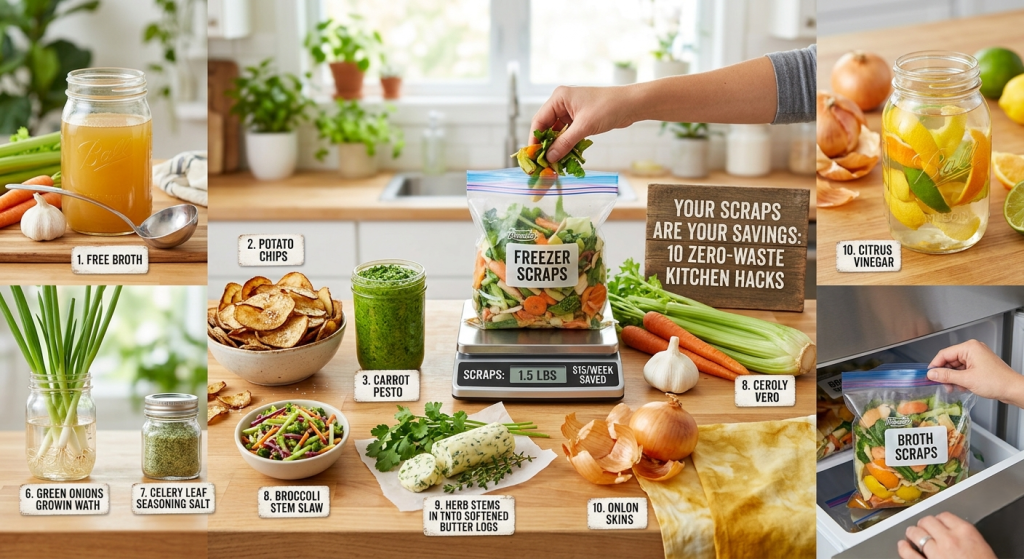
Every week, the average family fills a trash bag with vegetable peels, ends, and greens that could have become meals. Zero waste kitchen hacks transform what you’re throwing away into free food, cleaning products, and garden gold. It’s not about perfection—it’s about seeing scraps as ingredients you haven’t used yet.
These 10 zero waste kitchen hacks prove that vegetable scraps belong in your cooking, not your compost bin (yet). From broth that rivals expensive organic brands to snacks that disappear faster than chips, you’ll never look at carrot peels the same way again. Let’s turn your trash into treasure and slash your grocery bill while we’re at it.
Why Zero Waste Kitchen Hacks Matter
The Financial Impact
Food waste hits your wallet harder than you think. The USDA estimates the average American household throws away 30-40% of their food supply. For a family of four spending $800/month on groceries, that’s $240-320 monthly—nearly $3,000 annually—literally in the trash.
Vegetable scraps represent about 25% of that waste. By using zero waste kitchen hacks, you can recover $50–100/month in value from scraps you’re already buying:
- Homemade broth: Saves $4-8 per carton, makes 4-6 cartons monthly (Check The Ultimate Frugal Hack:How to Make Rich Vegetable Broth from Kitchen Scraps)
- Scrap snacks: Replaces $20-40/month in purchased chips and crackers
- Regrown vegetables: Green onions, celery, lettuce = $15-25/month saving
Environmental Benefits
According to the USDA, food waste accounts for 30–40% of the food supply in the United States.
Food waste in landfills produces methane, a greenhouse gas 25 times more potent than CO2. If food waste were a country, it would be the third-largest emitter globally. Every pound of vegetable scraps you use instead of trash reduces:
- Landfill methane production
- Water used to grow wasted food (250 billion gallons/year in the US alone)
- Carbon footprint from food transportation and disposal
1. Vegetable Scrap Broth (The Foundation Hack)
What to Save
Not all scraps make good broth. Here’s your cheat sheet:
YES—Freeze These:
- Onion skins and ends (adds color and sweetness)
- Carrot peels and tops (earthy sweetness)
- Celery leaves and ends (classic broth flavor)
- Mushroom stems (umami boost)
- Garlic peels and ends (aromatic depth)
- Herb stems (thyme, parsley, rosemary)
- Leek tops and roots (mild onion flavor)
- Parsnip peels (sweet, nutty)
NO—Compost These:
- Potato peels (makes broth cloudy and starchy)
- Brassica scraps (broccoli, cauliflower, cabbage—too sulfurous)
- Beet scraps (overpowers everything, turns broth red)
- Rotten or moldy pieces (obviously)
How to Make It
- Collect scraps in a gallon freezer bag until full (takes 2-4 weeks)
- Empty bag into stockpot with 4-6 quarts cold water
- Add aromatics: 2 bay leaves, 1 tsp peppercorns, 4-5 thyme sprigs
- Simmer 1-2 hours (don’t boil—makes broth cloudy)
- Strain through fine-mesh sieve or cheesecloth
- Cool and store: Refrigerate 5 days or freeze 6 months
Yield: One gallon bag = 3-4 quarts broth
Cost: Essentially free vs. $16-32 for equivalent organic broth
2. Crispy Potato Peel Chips
The Recipe
- Save peels from 4-5 russet potatoes (scrub well before peeling)
- Toss with: 2 tbsp olive oil, 1 tsp salt, optional seasonings (paprika, garlic powder, rosemary)
- Spread on baking sheet in single layer (don’t overlap)
- Bake at 400°F for 15-20 minutes, flipping halfway
- Watch closely—they burn fast near the end
- Cool 5 minutes (they crisp up as they cool)
Yield: Peels from 5 potatoes = 1 large bowl of chips
Cost: ~$0.50 vs. $4-6 for artisan potato chips
3. Carrot Top Pesto
Don’t Toss the Greens!
Carrot tops taste like a cross between parsley and carrots—earthy, slightly bitter, and delicious. They make excellent pesto that’s free if you’re already buying carrots.
The Recipe
- Wash 2 cups carrot tops thoroughly (gritty soil hides in the fronds)
- Combine in food processor:
– 2 cups packed carrot tops
– 1/2 cup nuts (walnuts, almonds, or pine nuts)
– 1/2 cup parmesan (or nutritional yeast for vegan)
– 2 garlic cloves
– 1/2 cup olive oil
– Salt and pepper to taste - Blend until smooth, scraping down sides
- Store in jar with thin oil layer on top (prevents browning)
Yield: About 1 cup pesto
Uses: Pasta, sandwiches, roasted vegetables, grain bowls
Shelf life: 1 week refrigerated, 3 months frozen
4. Regrow Green Onions (The Gift That Keeps Giving)
How to Regrow
- Cut green onions leaving 2-3 inches of white root end
- Place in glass with 1 inch of water (roots submerged, tops dry)
- Set on windowsill with indirect light
- Change water every 2-3 days
- Harvest when greens reach 6-8 inches (about 1 week)
- Repeat 3-4 times before roots exhaust themselves
Alternative: Plant in pot with soil for longer-term growth (up to 6 months of harvests)
Savings: One $2 bunch = 4-6 harvests = $8-12 value
5. Celery Leaf Seasoning Salt
Make Your Own Gourmet Salt
Celery leaves have intense flavor that concentrates beautifully when dried. This seasoning salt rivals expensive gourmet blends.
The Recipe
- Collect celery leaves from 2-3 bunches
- Wash and dry thoroughly (moisture = mold)
- Spread on baking sheet lined with parchment
- Dry in oven at lowest setting (170-200°F) for 2-3 hours until crispy
- Crush with fingers or spice grinder
- Mix with salt: 1 part celery powder to 4 parts sea salt
- Store in airtight jar up to 6 months
Uses: Bloody Mary rim, roasted vegetables, popcorn, grilled meats, eggs
Cost: Free vs. $8-12 for gourmet celery salt
6. Broccoli Stem Slaw
The Stem Is the Best Part
Broccoli stems are sweeter and more tender than the florets—they just need proper preparation. Don’t compost what should be coleslaw!
How to Prepare
- Peel the tough outer layer with vegetable peeler (reveals tender white interior)
- Julienne or shred with box grater or food processor
- Toss with dressing:
– 2 tbsp apple cider vinegar
– 1 tbsp olive oil
– 1 tsp honey or maple syrup
– Salt and pepper - Let sit 15 minutes (softens the slaw)
- Add-ins: Dried cranberries, sunflower seeds, shredded carrot
Yield: Stems from 2 broccoli heads = 4 servings slaw
Cost: Free side dish vs. $3-5 for prepared slaw
7. Herb Stem Compound Butter
Stems Have Flavor Too
Herb stems (especially cilantro, parsley, and thyme) contain as much flavor as leaves. Turn them into compound butter for instant gourmet upgrades.
The Recipe
- Chop stems finely from 1 bunch of herbs (about 1/2 cup)
- Soften 1 stick butter (room temperature, 1 hour)
- Mix together:
– 1 stick softened butter
– 1/2 cup chopped herb stems
– 2 cloves minced garlic
– 1 tsp lemon zest
– Salt and pepper - Roll in parchment into log shape
- Refrigerate until firm (2 hours) or freeze (3 months)
Uses: Melt over steak, stir into pasta, spread on bread, top roasted vegetables
Cost: $3 (butter) vs. $8-12 for gourmet compound butter
8. Onion Skin Natural Dye
Golden-Yellow Without Chemicals
Onion skins create beautiful, colorfast dye for fabric, eggs, or paper. It’s free, non-toxic, and produces stunning results.
Dyeing Fabric
- Collect skins from 15-20 yellow onions (about 2 cups)
- Simmer in 4 cups water for 1 hour
- Strain out skins (compost them)
- Soak fabric in dye bath for 1 hour to overnight (longer = deeper color)
- Rinse in cool water until water runs clear
- Hang to dry away from direct sunlight
Best fabrics: Natural fibers (cotton, linen, wool, silk)
Color: Golden yellow to amber brown (depends on concentration)
9. Vegetable Scrap Vinegar Cleaner
All-Purpose Cleaner from Scraps
Citrus peels (lemon, orange, grapefruit) infused in vinegar create a powerful, fresh-smelling cleaner that costs pennies to make.
The Recipe
- Fill jar with citrus peels (no pulp, it makes sticky cleaner)
- Cover with white vinegar (distilled, cheapest kind)
- Seal and store in dark place 2-4 weeks
- Strain out peels (compost them)
- Dilute for use: 1 part infused vinegar to 1 part water
- Add to spray bottle with 10 drops essential oil (optional)
Uses: Countertops, windows, floors, bathroom surfaces (not natural stone!)
Cost: ~$3 for 32 oz vs. $5-8 for equivalent natural cleaner
10. Freeze-Now, Use-Later Scrap System
The Key to Consistency
The biggest barrier to zero waste kitchen hacks is remembering to save scraps before they rot.. This system makes it automatic.
Setup Your Station
- Designate a gallon freezer bag labeled “BROTH SCRAPS”
- Keep it in freezer next to your prep area
- Add scraps as you cook (onion ends, carrot peels, celery tops, etc.)
- When full, make broth same day (or label with date and keep frozen)
- Start new bag immediately
Pro-Tip from the Shop
Blanch and freeze vegetable scraps if you won’t use them within 2 weeks. Raw scraps develop off-flavors in the freezer after about a month. To blanch: drop scraps in boiling water for 2 minutes, then plunge into ice water. Drain thoroughly, spread on baking sheet to freeze individually, then transfer to bags. This preserves fresh flavor for 6+ months and prevents freezer burn.
Cost Breakdown: Zero-Waste vs. Traditional
| Item | Zero-Waste Cost | Store-Bought Cost | Monthly Savings |
|---|---|---|---|
| Vegetable broth (4 quarts) | $0.50 (energy) | $16-24 | $15-23 |
| Potato chip snacks | $0.50 (oil, seasoning) | $12-18 | $11-17 |
| Pesto (1 cup) | $3 (nuts, cheese, oil) | $8-12 | $5-9 |
| Green onions (regrown) | $0.50 (initial bunch) | $8-12 | $7-11 |
| Celery seasoning salt | $0.25 (salt) | $8-12 | $7-11 |
| Compound butter | $3 (butter) | $8-12 | $5-9 |
| All-purpose cleaner | $3 (vinegar) | $15-24 | $12-21 |
| Total Monthly | $8.50 | $75-114 | $62-101 |
Annual Savings: $744-1,212 from scraps you’re already throwing away
Final Thoughts
Zero waste kitchen hacks aren’t about perfection or living in a mason jar. They’re about seeing value in what you already own—what you’re already buying, already peeling, already tossing. Every scrap you use is money saved, waste reduced, and a small rebellion against a system that tells you convenience is worth the cost.
Start with one hack. Make broth from scraps this week. Try potato peel chips next week. Add carrot top pesto when you buy carrots. Build the habit slowly, and within a month, you’ll automatically reach for the scrap bag instead of the trash.
Your wallet, your garden, and the planet will thank you. And honestly? Once you taste homemade vegetable broth, you’ll never go back to cartons.